How a Fast-Growing IT Services Firm Built a Scalable Learning Culture
Rapid growth is exciting. It signals market demand, client trust, and strong execution. But it also exposes organizational cracks faster than most leadership teams anticipate.
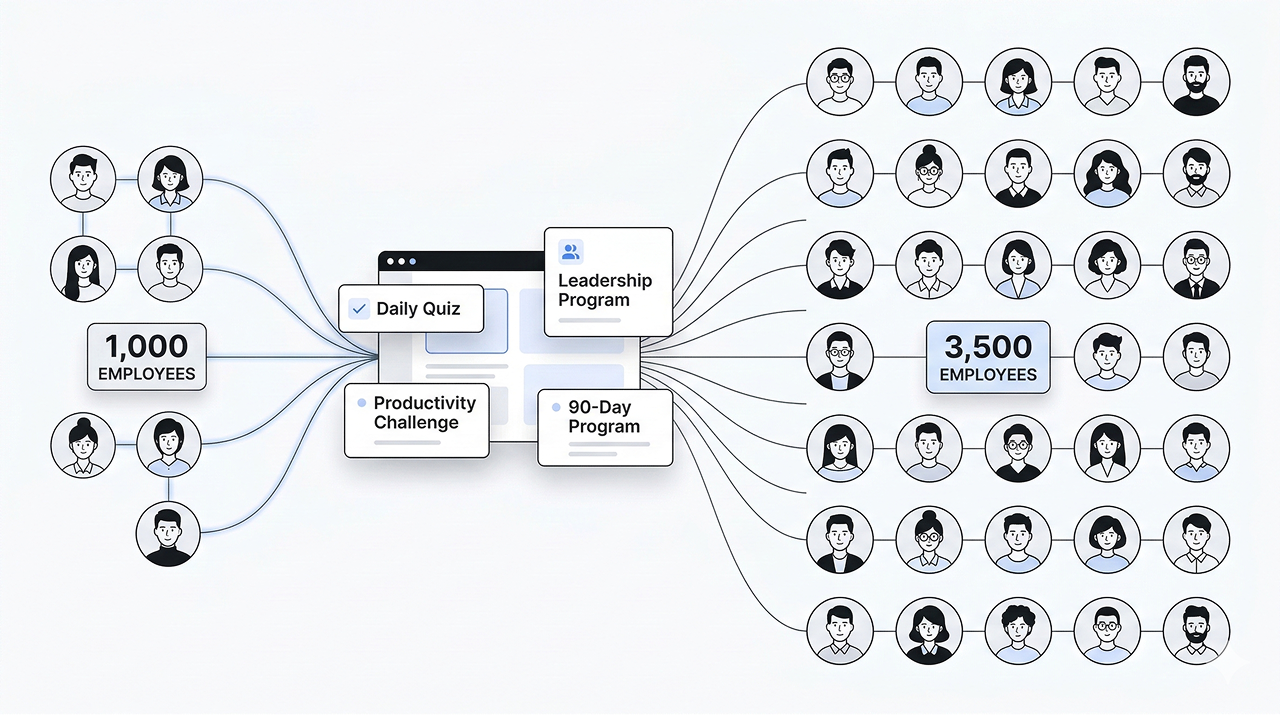
Over a span of just two years, a mid-size IT services company scaled its headcount from 1,000 to 3,500 employees. And with that growth came a pressing question:
How do you upskill a rapidly expanding workforce without slowing down delivery?
The company realized that traditional training approaches were no longer sufficient. Skills like productivity, leadership, and structured execution were no longer “nice to have.” They were essential operating capabilities.
This is the story of how they transitioned from fragmented learning interventions to a scalable, behavior-driven development model with Linear.
The Real Challenge Behind the Growth
On the surface, the need was clear: develop leadership and improve productivity across a distributed workforce of 1,000+ employees.
But the deeper issues were structural. Classroom-based leadership training was not scalable. Coordinating workshops across functions and geographies was operationally heavy and inconsistent in impact.
The organization also needed to build a strong pipeline of young leaders. Fast growth meant people were being promoted quickly. Without structured behavioral development, new managers were left to learn on the job, often through trial and error.
At the same time, productivity was slipping. Rapid expansion combined with increasing delivery pressure was diminishing outcomes. When work pressure mounted, learning was deprioritized leading to unaddressed skill gaps and unrealized potential
The organization did not need more content. It needed a system that worked inside the realities of a busy IT services environment.
Why They Chose Linear
The leadership team selected Linear for three fundamental reasons.
First, onboarding at scale was seamless. Over 1,000 users were onboarded with ease, without disrupting business continuity.
Second, the platform promoted active learning. Instead of passive video consumption, employees engaged in daily quizzes and real-world challenges that reinforced key concepts. This Learn → Do → Repeat → Routine model ensured that knowledge did not fade after a workshop but translated into behavior.
Third, users began picking up new skills that evolved into routines. That shift from information to habit, was the true differentiator.
The Learning Model That Drove Adoption
Each program ran for 90 days and followed a structured journey.
Employees enrolled into programs based on need and role relevance. They learned in cohorts, building peer accountability, and shared momentum. Daily learning took just 15 minutes through interactive sessions that fit inside demanding schedules.
To support adoption, internal campaigns educated employees on the method and its value. The result was sustained engagement.
Weekly active users exceeded 50%, a significant benchmark in corporate learning environments. Over time, employees completed approximately 25,000 quizzes and 13,000 real-world challenges. Many participants completed up to four programs within a year.
These were not vanity metrics. They represented repeated exposure, reinforcement, and application.
Measurable Outcomes That Matter
Adoption alone does not justify investment. Outcomes do.
The program delivered an 88% Net Promoter Score. Product experience was rated at 89%. Learning effectiveness stood at 84%. Most importantly, 87% of participants reported that the program helped them achieve their goals.
These numbers reflect more than satisfaction. They indicate behavioral change.
One participant noted that the curriculum “seeped in easily” and that they began applying the concepts subconsciously in daily life. Another described the delivery as simple and effective. A third reflected on how productivity techniques such as the Pomodoro method and “Eat the Frog” fundamentally changed their approach to time management.
When learning begins to shape daily behavior without forcing conscious effort, habit formation has taken place.
The Strategic Shift: From Training Events to Behavioral Infrastructure
What this IT services firm ultimately built was not just a learning program. They built behavioral infrastructure.
Instead of relying on occasional workshops that struggled to scale, they adopted daily micro-learning reinforced through repetition and application. Instead of leaving leadership development to chance, they created structured cohort journeys with accountability built in. Instead of lacking visibility, HR leaders gained real-time insight into engagement, progress, and capability growth. In doing so, the organization aligned growth with capability.
The Larger Lesson for Scaling Companies
Fast growth amplifies both strengths and weaknesses. Without deliberate behavioral development, productivity declines, leadership gaps widen, and culture fragments. This case demonstrates that scalable learning is not about longer programs or more content. It is about consistency, habit formation, and measurable execution.
When learning fits into the workday, reinforces itself through repetition, and connects directly to performance, it stops being an HR initiative and becomes an operating advantage.
For organizations scaling from hundreds to thousands of employees, that advantage compounds quickly. And as this IT services firm discovered, the right learning system does more than teach skills. It builds routines.
Experience habit-building and measurable growth with just 5 minutes of daily learning.